
When people search for medeco security locks, they are usually not looking for a simple padlock or a basic door lock. In most cases, they are responsible for protecting valuable assets, restricted rooms, outdoor cabinets, or infrastructure equipment where security failures can lead to serious operational or financial consequences. Medeco security locks have built a strong reputation in the market because they focus on mechanical strength, patented key control, and long-term reliability. These qualities explain why medeco security locks are still widely specified in many traditional security projects.
However, modern access control challenges are no longer only about how hard a lock is to break. Many organizations now care just as much about who accessed a lock, when it was opened, and whether that access was authorized for a specific task or time window. This shift in requirements is the reason why medeco security locks are increasingly compared with electronic lock systems, including Vanma passive electronic locks, especially in industries such as telecom, power utilities, transportation, and municipal infrastructure.
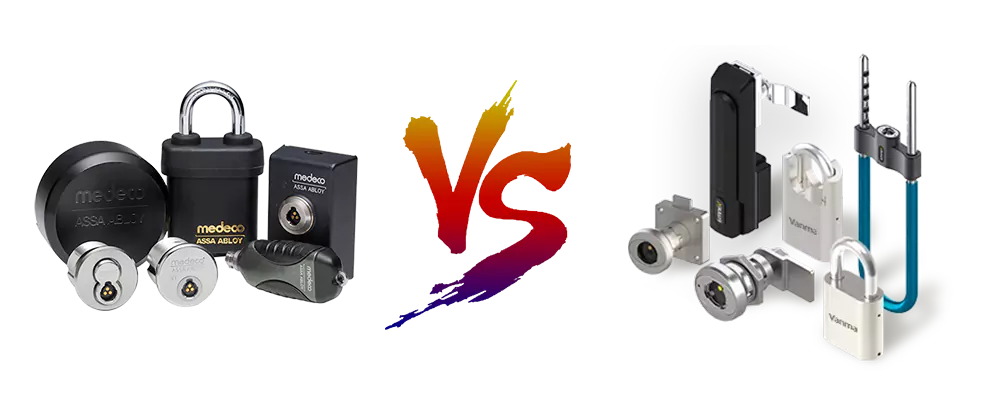
Medeco security locks are high-security mechanical locks designed to resist common physical attack methods such as picking, drilling, and bumping. Unlike standard mechanical locks, medeco security locks typically use angled pin technology combined with a sidebar mechanism. This means that the key must be inserted and rotated with precise alignment in multiple dimensions, making unauthorized manipulation far more difficult than with ordinary pin-tumbler locks.
Another major reason medeco security locks are trusted is their strict key control system. Keys are protected by patents and cannot be legally duplicated without authorization. For organizations that worry about uncontrolled key copying, this feature alone can significantly reduce internal security risks. In environments where access points are fixed and user turnover is low, medeco security locks can provide years of dependable protection without requiring frequent changes.
One of the biggest strengths of medeco security locks is their mechanical reliability. Because they do not rely on electronics, batteries, or software, they continue to function as long as the mechanical components remain intact. This makes them attractive for buyers who prefer a purely mechanical security solution with minimal technical complexity.
Medeco security locks are also well suited for compliance-driven environments where certified hardware is required. Many organizations value the long history of mechanical testing and certification associated with these locks. For interior doors, controlled offices, and areas where access rules rarely change, medeco security locks remain a practical and proven choice.
While medeco security locks perform well as individual locking devices, challenges often appear when they are deployed across large or distributed operations. The most common issue is key management. As the number of locks and users increases, managing physical keys becomes time-consuming and prone to error. Lost keys, staff changes, and emergency access requests can quickly turn into administrative headaches.
Another important limitation is the lack of visibility. Medeco security locks cannot record access events. There is no built-in way to know who opened a lock, at what time, or how frequently access occurs. For organizations that require audit trails, accountability, or operational transparency, this gap becomes more noticeable over time.
The comparison between medeco security locks and electronic lock systems usually begins with a simple question: is physical strength alone enough for modern security management. In many industries, the answer is increasingly no. Buyers now expect access control systems to support traceability, flexible authorization, and centralized management.
This is where electronic lock systems enter the discussion. Instead of relying solely on mechanical key control, electronic solutions focus on managing permissions, recording access behavior, and reducing the operational burden of physical key distribution. For organizations managing hundreds or thousands of access points, these features can make a measurable difference in efficiency and risk reduction.
Vanma passive electronic locks represent a different way of thinking about access control. Unlike active electronic locks, Vanma locks do not contain internal batteries or require wired power connections. The lock itself remains passive, while the electronic key provides the energy and authorization during each operation. This design allows Vanma locks to combine electronic access control with the durability needed for outdoor and industrial environments.
From an operational perspective, Vanma passive electronic locks shift control away from the physical lock and toward centralized permission management. A single electronic key can be authorized to open multiple locks, but only within defined rules such as time periods, locations, or task assignments. This approach directly addresses many of the management challenges associated with large deployments of medeco security locks.
In practice, Vanma passive electronic locks are often chosen in scenarios where access rules change frequently or where access records are mandatory. Examples include telecom cabinets distributed across cities, power distribution boxes in remote locations, railway signal cabinets, and municipal infrastructure that requires regular inspection and maintenance.
In these environments, the ability to assign temporary access, revoke permissions remotely, and review opening and closing records becomes more valuable than relying solely on mechanical resistance. This does not mean medeco security locks are ineffective, but rather that their design does not address these specific operational needs.
Many organizations do not see this as an either-or decision. Medeco security locks and Vanma electronic locks can coexist within the same security strategy. Mechanical locks may continue to protect static indoor areas, while electronic locks manage high-risk or high-frequency access points.
This hybrid approach allows companies to protect existing investments in medeco security locks while gradually introducing electronic access management where it delivers the most value. Over time, access patterns and operational data can guide further decisions.
Choosing between medeco security locks and Vanma passive electronic locks depends on how access is actually used. If access points rarely change and audit records are not required, mechanical locks may remain sufficient. If access permissions change often, staff turnover is high, or compliance reporting is required, electronic lock systems become more attractive.
The key is to evaluate security not only as physical protection, but as part of a broader operational system that includes people, processes, and accountability.
Medeco security locks are best suited for environments where strong mechanical protection and strict key control are the primary requirements. They work well on interior doors, controlled rooms, and facilities with stable access rules and limited user changes.
Medeco security locks can be used outdoors if properly protected, but they do not provide access records or remote permission management. In outdoor infrastructure environments, these limitations often become more noticeable over time.
No. Medeco security locks are purely mechanical and do not record who opened a lock or when it was accessed. Any audit process must rely on external procedures rather than built-in data.
No. Vanma passive electronic locks do not contain internal batteries. The electronic key supplies power during the unlocking process, which helps reduce maintenance and improves long-term reliability in harsh environments.
Security depends on the use case. Mechanical locks focus on physical resistance, while electronic systems focus on control, visibility, and accountability. In many modern operations, a combination of both delivers the best overall result.
Medeco security locks remain a respected and reliable solution for many traditional security applications. Their mechanical strength and key control continue to meet the needs of organizations with stable and predictable access requirements. At the same time, evolving operational demands are pushing many buyers to consider electronic alternatives.
Vanma passive electronic locks address challenges that mechanical locks were never designed to solve, such as dynamic authorization, access traceability, and centralized management. For modern infrastructure and distributed assets, these capabilities can significantly improve both security and operational efficiency. The most effective security strategies today are those that match the lock technology to real-world usage, rather than relying on tradition alone.

