
Locks Industrial Buyers Use: What Matters for Security?
When buyers search for locks industrial facilities can depend on, the real concern is rarely just whether a lock can keep a door closed. Industrial security involves protecting equipment, production areas, electrical systems, telecom infrastructure, warehouses, utilities, technical rooms, remote cabinets, and restricted operational zones. A suitable industrial locking system must therefore combine physical resistance with practical access management, environmental durability, maintenance efficiency, and clear control over who is allowed to open each locking point.
What Does "Locks Industrial" Mean in B2B Security?
In procurement terms, locks industrial organizations use are security devices designed for tougher conditions and more complex access requirements than ordinary residential hardware. These locks may protect steel doors, outdoor gates, switchgear cabinets, telecom shelters, substations, machinery enclosures, warehouse rooms, control panels, storage buildings, railway facilities, and other restricted assets.
The category includes mechanical cylinders, heavy-duty padlocks, cabinet locks, electronic locks, smart-key systems, and passive electronic locking solutions. The correct technology depends on what must be protected, how many people require access, how often permissions change, whether sites are connected to power or networks, and how important access records are to the organization.
For purchasing managers, this means a product should not be judged only by its lock body or cylinder. The entire access process matters. A highly resistant lock can still create a security problem if too many uncontrolled keys exist, while a sophisticated electronic system may be unnecessarily complex for a low-risk internal storeroom.
Why Industrial Facilities Need Specialized Locks
Industrial sites place very different demands on locking hardware. A lock may be opened several times every shift, installed outdoors for years, exposed to dust or moisture, or operated by contractors who only need temporary access. These conditions make both hardware quality and access-management design important during procurement.
Physical Attack Resistance
Physical resistance is usually the first requirement. Industrial locks may protect expensive machinery, copper cables, electrical control systems, spare parts, hazardous materials, or infrastructure that cannot be easily replaced. Buyers should therefore evaluate the material of the lock body, locking bolt, cylinder, shackle, mounting structure, and surrounding door or cabinet.
A strong lock fitted to a thin hasp offers limited security. Likewise, a reinforced industrial door may still be vulnerable if the cylinder is poorly protected. Security managers should treat the lock, door, hinges, frame, mounting hardware, and surrounding structure as one complete barrier.
Controlled Employee and Contractor Access
Access complexity is another major difference between industrial and ordinary locking applications. Maintenance engineers, security personnel, plant managers, equipment suppliers, external contractors, cleaning staff, and emergency teams may all require different levels of access.
The problem becomes more serious when the same organization operates hundreds of locks. Traditional keys can be difficult to track, especially when employees change roles or contractors leave a project. If a key is copied or not returned, management may have no practical way to know whether unauthorized access remains possible.
Harsh Environmental Conditions
Industrial locking hardware often operates in conditions that shorten the service life of ordinary locks. Outdoor installations can face rain, dust, freezing weather, high temperatures, humidity, salt spray, and direct sunlight. Factories may expose locks to vibration, metal particles, oil, chemicals, or frequent impact.
Buyers should therefore examine material selection, sealing, corrosion resistance, operating temperature, and environmental protection. These specifications become especially important at remote sites because a failed lock can require a technician to travel long distances simply to restore access.
Common Industrial Lock Types
Different security problems call for different locking technologies. Understanding the advantages and limits of each type helps buyers avoid choosing products based on price or appearance alone.
Mechanical Industrial Locks
Mechanical industrial locks remain widely used because they are simple, familiar, and independent of software. Heavy-duty cylinders, deadbolts, mortise locks, cabinet locks, and other mechanical designs can provide reliable protection where the number of users is limited and access permissions rarely change.
Their main weakness appears in key administration. Once a mechanical key is issued, the organization relies on physically recovering it when access should end. If the key is lost or copied, the response may involve replacing a cylinder or changing part of the master-key system.
Industrial Padlocks
Industrial padlocks are practical for gates, enclosures, equipment rooms, storage areas, service doors, containers, and sites where the locking point needs to remain flexible. Their performance depends not only on shackle strength but also on corrosion resistance, lock-body material, cylinder security, shackle exposure, and the quality of the hasp.
They are also convenient for retrofitting because replacing a conventional padlock with an electronic or smart industrial padlock may require fewer modifications than rebuilding the complete door locking structure.
Electronic Industrial Locks
Electronic locks add digital identity and permission management to the physical lock. Depending on the system, access may be granted using a smart key, card, PIN, mobile credential, biometric identity, or another electronic credential.
This becomes valuable when managers need to assign access individually. A technician can be authorized for certain equipment rooms while a contractor receives access only to the locations required for a specific job. Permissions may also be limited by time, reducing the need to issue permanent access for temporary work.
Passive Electronic Locks
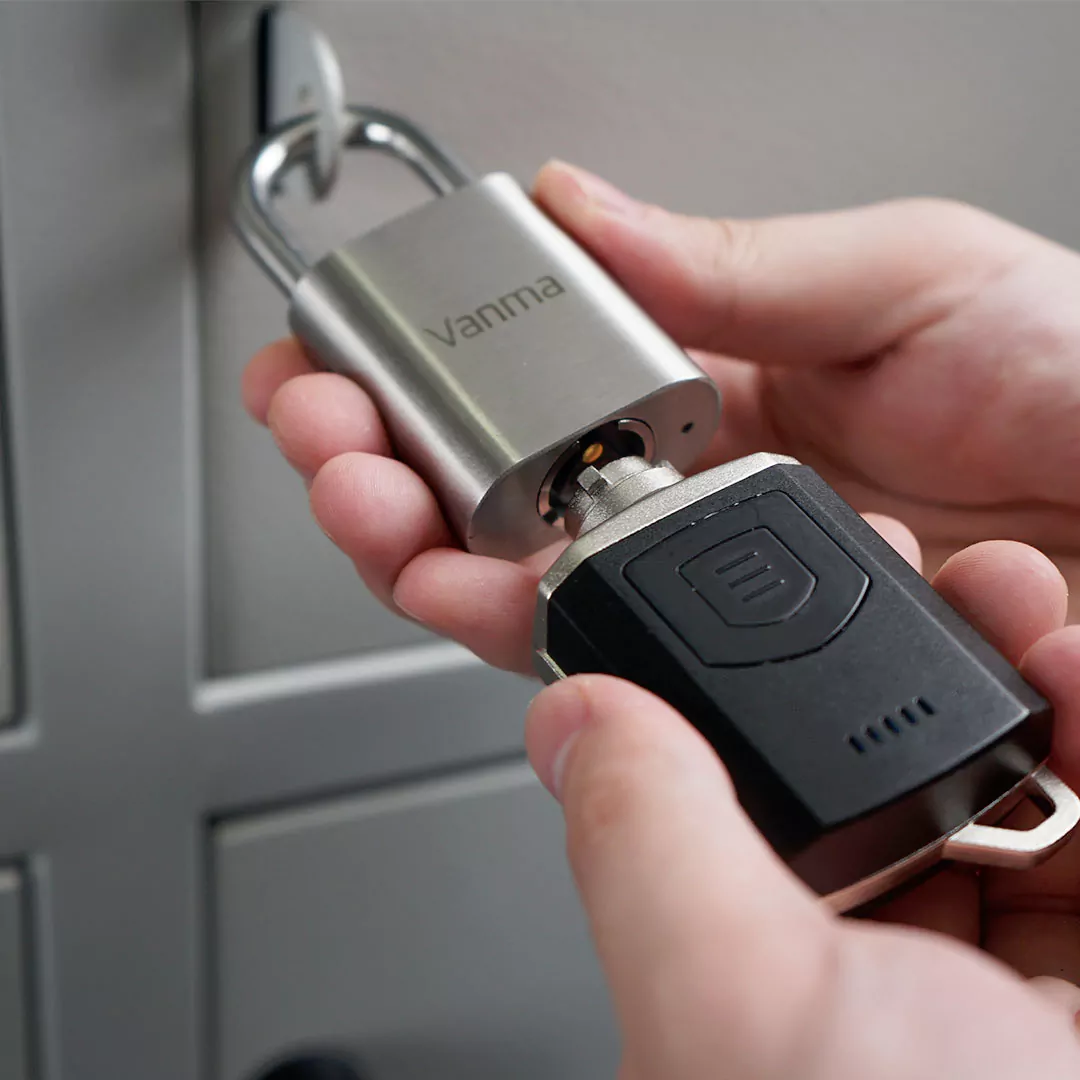
Passive electronic locks take a different approach by keeping the locking point itself free from an internal battery. Instead, the authorized electronic key supplies power when it contacts the lock. This allows the system to provide electronic authorization without placing a battery or permanent power connection inside every locking point.
For utilities, telecom networks, transportation infrastructure, warehouses, factories, outdoor gates, and remote equipment rooms, this can reduce maintenance requirements. It is particularly useful when an organization wants stronger access control across many dispersed locks but does not want technicians replacing batteries at every site.
Where High-Security Industrial Locks Are Used
High-security locking requirements appear across many industries, but the security priorities differ from site to site. Buyers should begin with the operational risk rather than assuming one standard lock should be installed everywhere.
Power and Utility Infrastructure
Power facilities often contain transformers, switchgear, electrical cabinets, control rooms, substations, and outdoor equipment that must only be accessed by qualified personnel. Unauthorized access can cause equipment damage, safety incidents, service interruption, or theft.
Because many utility assets are geographically dispersed, key management can become as important as the lock hardware itself. A centralized authorization system can help reduce the number of uncontrolled physical keys circulating among maintenance teams.
Telecom and Remote Sites
Telecom operators may manage cabinets, towers, shelters, equipment rooms, and outdoor sites across large service areas. Different maintenance teams and contractors may need access at different times, making traditional master-key systems difficult to control.
Electronic smart-key solutions can provide more precise permission management without requiring every remote cabinet to have network connectivity. This makes passive electronic locking particularly relevant to distributed infrastructure.
Factories and Production Facilities
Manufacturing plants commonly contain restricted machine rooms, production areas, tool rooms, electrical cabinets, maintenance workshops, control rooms, chemical storage areas, and spare-part warehouses. Different employees require different levels of access, and access privileges can change as workers move between departments.
Industrial locking systems can therefore support both safety and asset protection. Facility managers can separate access according to role rather than relying on broad master keys that open multiple unrelated areas.
Warehouses and Logistics Centers
Warehouses must protect inventory while still allowing frequent movement of employees, drivers, technicians, and contractors. High-value storage zones, bonded goods, tool rooms, spare parts, and restricted inventory areas may justify stronger access control than general warehouse space.
When access events can be linked to individual credentials, security teams have more information available when investigating missing inventory or abnormal entry activity.
Transportation and Infrastructure Sites
Railway facilities, ports, roadside infrastructure, transportation depots, tunnels, equipment cabinets, and maintenance compounds often contain distributed assets in outdoor environments. Locks used here may need to combine corrosion resistance, physical strength, and simplified authorization for maintenance teams operating across multiple locations.
What Should Buyers Check Before Selecting Industrial Locks?
A good industrial lock specification begins with operational requirements. Buyers should identify what the lock protects, who requires access, how frequently authorization changes, and how difficult it will be to maintain the locking point over its service life.
| Procurement Factor | Questions Buyers Should Ask |
|---|---|
| Application | Is the lock protecting a door, gate, cabinet, equipment enclosure, warehouse, or remote infrastructure site? |
| Physical Security | What attack resistance is required from the cylinder, lock body, shackle, bolt, and surrounding hardware? |
| Environment | Will the lock face water, dust, humidity, salt, extreme temperatures, vibration, or chemicals? |
| Number of Users | How many employees, contractors, and maintenance personnel require access? |
| Permission Changes | How frequently are users added, removed, or reassigned? |
| Audit Requirements | Does management need to know who accessed a location and when? |
| Lost Key Response | Can a lost credential be disabled without replacing every lock it could open? |
| Maintenance | Does the lock require batteries, wiring, network connectivity, lubrication, or periodic servicing? |
| Scalability | Will the system still be manageable if the number of locks grows from dozens to thousands? |
Mechanical vs Electronic Industrial Locking
Mechanical and electronic locks should not be compared simply as old technology versus new technology. Mechanical locks remain practical for many applications. The decision depends on how complicated access management becomes over time.
| Feature | Mechanical Industrial Lock | Electronic Industrial Lock | Passive Electronic Lock |
|---|---|---|---|
| Access Credential | Mechanical key | Card, PIN, electronic key, mobile or biometric credential | Electronic smart key |
| Individual Permissions | Limited | Available | Available |
| Time-Based Access | Usually unavailable | Often available | Often available |
| Access Records | Usually unavailable | Often available | Often available |
| Power Requirement at Lock | None | Usually battery or wired power | No internal lock battery |
| Lost Credential Management | May require rekeying | Credential can usually be revoked | Smart-key authorization can be changed |
| Remote-Site Maintenance | Low electronic maintenance | Depends on system architecture | Reduced lock-side electronic maintenance |
Why Key Management Becomes a Security Problem
The biggest weakness in many industrial lock systems is not the lock itself but the uncontrolled key. A company may begin with ten doors and ten employees, where traditional key management appears simple. As the organization expands, the same structure can grow into hundreds of locks, master keys, duplicate keys, contractors, departments, and temporary users.
When an employee leaves, security staff must know exactly which keys were issued and whether duplicates exist. If a master key disappears, management may face the expensive choice of accepting the risk or replacing multiple cylinders.
The operational cost also matters. Technicians may have to travel to an office to collect keys before visiting a remote site. Security staff spend time issuing, signing out, returning, storing, and auditing physical keys. These processes do not always appear in the original lock purchase price, but they can become a significant lifecycle expense.
How Passive Electronic Locks Change Key Management
Passive electronic locking changes the role of the key from a permanent mechanical credential into a programmable authorization device. Instead of relying solely on the physical shape of a key, the system can determine which locks a user is permitted to open.
This gives security teams more flexibility. A technician may be authorized for a selected group of locks, while a contractor receives access only to one area during a defined maintenance period. When permissions change, administrators can update the authorization strategy without mechanically replacing every affected lock.
The lack of an internal lock battery is also important for large deployments. When hundreds or thousands of locks are distributed across outdoor or remote locations, routine battery replacement at every locking point can create a considerable maintenance workload.
Where Vanma Lock Fits in Industrial Security
Vanma Lock is designed around a passive electronic locking architecture in which the lock itself does not require an internal battery. Power and authorization are delivered through the electronic smart key during access. This structure is relevant for organizations that want electronic permission control but need to avoid installing power wiring or maintaining batteries across large numbers of locks.
The system can be applied across different industrial locking points, allowing security teams to manage access according to personnel, time, and location. Access records also provide a clearer operational trail than conventional mechanical keys when facilities need greater accountability.
Organizations evaluating passive locks can review the available Vanma industrial lock options and compare the lock format with their existing doors, cabinets, gates, and equipment enclosures.
The most important point is not to replace every mechanical lock simply because electronic technology is available. A better approach is to identify where key control, auditability, or remote-site maintenance creates a measurable problem, then determine whether passive electronic locking solves that specific problem.
What Affects the Total Cost of Industrial Locks?
Industrial lock procurement should consider lifecycle cost rather than hardware price alone. A low-cost lock can become expensive if it requires frequent replacement, regular battery servicing, repeated cylinder changes, or costly technician visits.
Mechanical systems may have relatively simple hardware costs but can generate ongoing expenses through lost keys, duplicate keys, rekeying, key cabinets, and administrative labor. Conventional electronic locks may improve authorization management but add battery replacement, wiring, network, or software requirements depending on the architecture.
Passive electronic locks shift some of that maintenance away from the individual locking point. However, buyers should still evaluate software management, smart-key quantities, training, spare keys, integration requirements, technical support, and future expansion.
For large projects, the best comparison is often a five- or ten-year cost model that includes hardware, installation, maintenance visits, credential replacement, lock replacement, administration, and potential expansion rather than comparing unit prices alone.
FAQ About Locks Industrial Buyers Commonly Consider
What is the difference between industrial and standard locks?
Industrial locks are selected for more demanding physical, environmental, and operational conditions. They may need to withstand outdoor exposure, repeated use, corrosion, higher attack risks, and more complicated user management. Standard residential locks are generally designed for fewer users and less demanding environments.
Are passive electronic locks suitable for outdoor sites?
They can be suitable when the specific lock is designed for the intended environmental conditions. Buyers should review water and dust protection, corrosion resistance, operating temperature, material construction, and installation design. The surrounding gate, door, cabinet, or hasp must also be suitable for outdoor use.
Can one electronic key manage multiple locks?
In systems designed around programmable smart keys, one authorized electronic key can often be used with multiple compatible locks. The value is that the key's permissions can be defined according to the user's role rather than requiring the user to carry a separate mechanical key for every locking point.
What happens when an electronic key is lost?
The response depends on the locking system, but electronic authorization generally gives administrators more options than a conventional mechanical key. Permissions associated with a lost credential can be changed or revoked according to the system design, reducing the need to replace large numbers of physical locks solely because one credential has disappeared.
Which industries benefit most from electronic industrial locks?
Electronic industrial locks are particularly useful in industries with many users, frequent personnel changes, distributed facilities, valuable equipment, high-security areas, or a need for access records. Typical applications include power, utilities, telecom, manufacturing, transportation, logistics, warehousing, energy, public infrastructure, mining, banking facilities, and other sites where unauthorized access can create significant operational risk.
Should every industrial lock be electronic?
No. Low-risk areas with stable access requirements may be adequately protected by well-selected mechanical locks. Electronic locking is most valuable where organizations need better credential control, time-based permissions, access accountability, or simpler management across many locations. A mixed locking strategy can therefore be more practical than replacing every lock with the same technology.
How should a buyer test locks before a large rollout?
A pilot deployment is often the safest approach. Select representative doors, cabinets, gates, or remote sites and test the locks under actual operating conditions. Include different user groups, environmental conditions, access frequencies, and maintenance scenarios. This helps the procurement team identify installation issues, workflow problems, training requirements, and hardware compatibility before committing to a large project.
Final Industrial Lock Procurement Checklist
Choosing locks industrial sites can rely on requires more than comparing cylinders, shackles, or purchase prices. The strongest procurement decisions connect physical hardware with the way people actually access and manage the facility.
- Identify exactly what each locking point protects.
- Assess the security risk if unauthorized access occurs.
- Confirm door, gate, cabinet, or enclosure compatibility.
- Review environmental exposure and corrosion requirements.
- Count the number of users, locks, and locations.
- Determine how frequently access permissions change.
- Decide whether temporary or time-limited authorization is required.
- Establish whether access records are necessary.
- Define the response procedure for lost credentials.
- Compare battery, wiring, network, and maintenance requirements.
- Evaluate future scalability before standardizing a system.
- Calculate lifecycle cost instead of relying only on unit price.
- Test representative locks before a large-scale deployment.
For companies managing only a few controlled doors, a reliable mechanical locking system may remain the simplest answer. For organizations operating large numbers of high-security doors, cabinets, gates, or remote infrastructure sites, programmable electronic authorization can provide better control over users and credentials. Buyers considering a project can contact the Vanma team to discuss lock formats, operating environments, access requirements, and deployment scale before selecting a final solution.

