
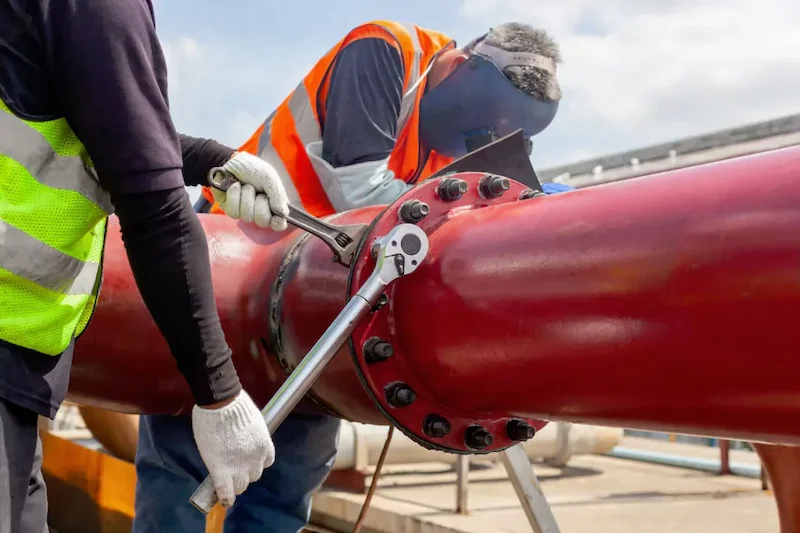
Walk around any active chemical plant or oil refinery long enough and you will find something uncomfortable: maintenance crews who treat blind flange operations like a routine pipe job. Crack a few bolts, swap the plate, close everything back up, and move on. No big deal.
Except it is a very big deal. Blind flange work means deliberately breaking the seal on a live industrial pipeline — often one that has carried toxic, flammable, or highly pressurized media minutes before. The physical act of installing or removing that solid metal plate is what stands between a controlled maintenance window and a serious incident. Get the procedure wrong, skip a step under deadline pressure, or use the wrong tools because the right ones are in another building — and people get hurt.
This guide covers the full picture: what these operations actually involve, what the safety standards require, and where modern access control technology like the Vanma smart lock system closes the gaps that paperwork alone never could. Whether you are a safety manager writing procedures, a supervisor briefing a crew, or a technician looking to refresh your understanding — read this before you touch a flange.

What Are Blind Flange Plugging and Pulling Operations?
A blind flange — sometimes called a blind plate or spectacle blind — is a solid metal disc installed between two pipe flanges to physically block the flow of media through that section of pipeline. Unlike a valve, which has moving parts and mechanical seals that can fail, a blind flange provides absolute isolation. There is nothing to leak, nothing to rotate partially open, and no internal seat to corrode.
Plugging is the act of inserting that blind plate into the flange joint — isolating the section. Pulling is the act of removing it — restoring flow. Both actions require the pipe seal to be broken open, which is exactly what makes this a classified "special operation" in chemical, petrochemical, and industrial safety frameworks worldwide.
The moment you loosen those flange bolts, you are exposed to whatever residual media is still present in the system — even after depressurization and draining. Steam condensate, trapped liquid pockets, dissolved gases, and corrosive films do not just disappear because the pressure gauge reads zero. Treating this as a low-risk job because "the line is isolated" is how incidents happen.
Why Blind Flange Operations Are Classified as Special Operations
Most industrial safety regulations — including China's GB 30871 standards and international equivalents — classify blind flange plugging and pulling operations separately from general maintenance. The classification triggers additional permit requirements, dedicated supervision, and stricter PPE rules. This is not bureaucratic overhead. It is a direct response to decades of incident data showing that the specific window when a pipeline seal is broken accounts for a disproportionate share of chemical plant injuries.
Five Pre-Job Checks for Blind Flange Plugging and Pulling Operations
The physical act of changing a blind plate takes maybe 30 minutes. A proper pre-job preparation process takes longer — and that is intentional. Every shortcut taken before the wrench comes out multiplies the risk exponentially. These are the five checks that experienced safety managers treat as non-negotiable.
1. Depressurization — and Verify It Twice
The pipeline system pressure must be reduced to normal atmospheric pressure before any flange bolts are loosened. This sounds obvious, but the failure mode is usually a faulty instrument — not a skipped step. Pressure gauges in industrial environments get clogged with process debris, suffer sensor drift, or get knocked out of calibration. A gauge that reads zero is not proof of zero pressure.
The correct approach is to depressurize through a separate bleed point, confirm with a secondary gauge, and physically vent to atmosphere before proceeding. If there is any doubt about gauge accuracy, treat the line as pressurized until proven otherwise.
2. Ventilation and Continuous Gas Monitoring
Good ventilation at the work site is not a one-time setup. Natural air movement shifts throughout a shift. Pockets of heavier-than-air gases can accumulate in low spots, drain pits, or under grated flooring even after a purge procedure that tested clean.
Gas detectors need to be running and actively monitored — not sitting in a tool bag. Assign someone specifically to watch the readings during the entire operation. If an alarm sounds, the job stops. Full stop. Not "let us finish this bolt and then check." Stop and evacuate.
3. Dedicated On-Site Supervision
Every blind flange plugging and pulling operation requires a designated supervisor whose only job during the operation is to monitor it. Not turning wrenches, not fetching parts, not on a radio dealing with a separate issue on the other side of the plant. Watching. This person monitors air quality readings, keeps unauthorized personnel out of the exclusion zone, and has the authority to halt the job immediately if conditions change.
4. Blind Plate Location Map and Unified Numbering
Before the first blind goes in, every single installation point must be plotted on a physical drawing — not a mental note, not a verbal briefing. Each blind plate gets a unique number that links it to the location map, the permit, and the sign-off record.
This step exists because of a specific failure mode that has shut down plants and destroyed equipment: a blind plate that does not get pulled when a system restarts. When plates are tracked on paper notes or in someone's memory, they get missed. When every plate has a number that must be checked off by two people before restart authorization is issued, they do not get missed.
5. Clear Communication with Adjacent Operations
Blind flange work does not happen in isolation from the rest of the plant. The control room, adjacent unit supervisors, and any contractors working nearby all need to know the job is happening, where it is, and what the exclusion zone looks like. This coordination step is often treated as optional — it is not.
PPE and Tool Requirements for Blind Flange Plugging and Pulling Operations
The right gear is not a suggestion. It is the last line of defense when something goes wrong despite all the planning. Here is what is required for different hazard environments.
Explosion-Proof Tools — No Exceptions
In areas classified as fire or explosion hazards, every tool used during blind flange plugging and pulling operations must be explosion-proof — typically non-sparking alloys like aluminum bronze or beryllium copper. A standard steel wrench striking a carbon steel pipe in the presence of a flammable gas pocket creates a spark. That spark is sometimes enough to ignite a flash fire.
The most common failure here is not ignorance — it is convenience. A technician needs a specific size and the explosion-proof version is locked in a cage on the other side of the plant. So they use what they have. This is exactly the scenario shown in the training video that motivated this article: "The blind is in, the line is purged, it is fine." It is not fine. Purging reduces the hazard; it does not eliminate it. Explosion-proof tools are mandatory because the consequences of the exception are catastrophic.
Anti-Static Clothing and Footwear
Static discharge from the human body is a real ignition source in flammable atmospheres. Workers must wear anti-static work clothes and anti-static work shoes during blind flange operations in hazardous zones. Synthetic fabrics — polyester fleece, nylon outerwear — generate and hold static charge as workers move. They have no place near an open flange in a fire-hazard environment.
Chemical Protection for Corrosive Media
When the pipeline contains or has recently carried highly corrosive media — concentrated acids, caustic solutions, or reactive chemicals — standard coveralls are inadequate. Workers need specific chemical-resistant gear: acid-resistant aprons, full face shields (not just safety glasses), chemical-resistant gloves, and in some cases full chemical suits. Residual media clings to pipe walls and flange faces. When the joint opens, it drips, sprays, or releases vapor. The face and hands are the most exposed.
Hard Rules: What Is Absolutely Prohibited During Blind Flange Operations
Some safety rules are guidelines. These are not guidelines. These are hard stops that exist because someone, somewhere, learned the lesson the worst possible way.
No Hot Work Within 30 Meters
Any open-flame work — welding, cutting, grinding, or any other operation that produces sparks — is strictly prohibited within 30 meters of an active blind flange plugging or pulling operation. The exclusion zone is not a suggestion based on typical gas dispersion patterns; it is a fixed minimum. When a flange is being worked on, the potential for sudden gas release exists regardless of what the gas monitors currently read. Wind shifts. Pockets move. The 30-meter rule exists because gas travels faster than the reaction time of a welder who "didn't know they were working near an open flange."
Never Run Two Blind Flange Operations on the Same Pipeline Simultaneously
This prohibition is one of the most commonly violated in plants that are rushing to meet a maintenance schedule. Running two crews on opposite ends of the same pipe at the same time feels efficient. It is actually dangerous.
When one end of a pipe section is opened, pressure dynamics inside change. Trapped gas or liquid can be pushed toward the second open flange face where the other crew is working. The two crews have no visibility into each other's status. One crew's "safe" environment changes the moment the other crew cracks their joint. Operations must be sequential — one location at a time, one team, one confirmed safe state before moving to the next.
Permit-to-Work Rules for Blind Flange Plugging and Pulling Operations
Permit-to-Work (PTW) systems are one of the most effective tools in industrial safety — when they are used correctly. In the context of blind flange operations, the rules are very specific, and they exist to prevent a particular type of failure: lost plates, missed pull-outs, and work done without verified authorization.
One Permit Per Action Per Blind Plate
The plugging action and the pulling action for the same blind plate require two entirely separate blind plate safety operation permits. These are not interchangeable. You cannot issue one permit covering "installation and future removal" of a blind plate. You cannot use a permit for one blind plate to cover another plate at a different location.
One permit. One plate. One action. This is not paperwork for its own sake. Every physical plate in a system should have a corresponding, active permit document that any supervisor or inspector can trace. If a plate does not have an associated permit, it should not be in the system. If a permit cannot be traced to a physical plate, an investigation is warranted.
Dual Sign-Off at Job Close-Out
When the physical work is done, the job is not finished. The operation unit — the crew that turned the wrenches — and a dedicated representative from the enterprise (typically a safety officer or area supervisor) must physically walk the site together. They inspect the flange, check adjacent valves and isolation points, and jointly confirm that the site is in the correct state before the permit is closed.
This dual-confirmation step exists because the person who does the work and the person who verifies it should not be the same individual. Tired technicians miss things. Having a fresh set of eyes do the close-out walk is a simple, effective catch for overlooked items.

Closing the Gap: How the Vanma Smart Lock System Strengthens Blind Flange Operations
Here is the honest problem with traditional lockout systems in the context of blind flange plugging and pulling operations: the physical security layer is almost always the weakest link.
You can write a meticulous Permit-to-Work document. You can brief the crew thoroughly. You can install the blind correctly. But then you secure the isolation valve — the one that must stay closed for the entire duration of the job — with a standard padlock and a paper tag. That tag gets soaked in process fluid. It tears off. The key gets handed to three different people over a 12-hour shift. And occasionally, someone with bolt cutters decides the maintenance schedule is more important than the paper on the handle.

What the Vanma Smart Lock System Actually Does
The Vanma smart lock system replaces the traditional padlock-and-tag combination with something that cannot be bypassed by convenience or impatience. The physical lock housing has no mechanical keyhole — it opens only via a programmed electronic key. That key can be configured with specific access permissions that expire automatically.
In a blind flange plugging and pulling scenario, here is what that looks like in practice: the safety manager issues a permit, then programs the corresponding Vanma key so that only the authorized technician — say, one specific person — can open that isolation point. The access window matches exactly the time authorized on the permit. Nobody else's key opens that lock. The authorized technician's key stops working the moment the permit window closes. If they forget a tool and try to re-enter outside the permit window, access is denied and the attempt is logged.
A Digital Audit Trail That Paper Cannot Provide
Every interaction with every Vanma lock — successful access, denied access, key used, time stamp, location — is recorded automatically in the system software. For blind flange operations specifically, this means the dual-confirmation sign-off at job close-out is backed by objective data, not just signatures on a paper form.
If a permit was closed but the lock was accessed again twenty minutes later, the log shows it. If an isolation point was opened before the permit was formally issued, the log shows that too. When an incident investigation happens months later, the question of "who had access and when" has a definitive answer instead of a collection of conflicting recollections.
Fitting into Existing Hazardous Energy Control Procedures
The Vanma system does not replace a Permit-to-Work process — it enforces it. The permit defines who is authorized, for what task, at which location, and during which time window. The Vanma lock translates that authorization into physical access control. The two systems work together: the permit is the policy layer, and the smart lock is the enforcement layer.
For facilities running multiple blind flange operations across large sites, this also solves a real operational headache: physical key management. Traditional lockout programs accumulate dozens of padlocks and keys, all of which need to be tracked, issued, recovered, and audited. The Vanma system manages all of that centrally, with access permissions granted and revoked through software rather than physical key handoffs.
The Most Common Mistakes in Blind Flange Plugging and Pulling Operations
After reviewing incident reports and talking to site safety managers across multiple industries, the same failures show up repeatedly. None of them are exotic. Most of them happen because of schedule pressure, familiarity, or a well-meaning shortcut.
① Trusting a single pressure gauge
One failed or clogged gauge has been the proximate cause of more flange incidents than any other single factor. Always verify pressure through a secondary bleed point before breaking a joint.
② Using ordinary tools "just this once"
The reasoning is always the same: the line is purged, the job is almost done, the right tool is far away. The hazard does not care about any of that. Explosion-proof tools are not negotiable in classified areas.
③ Skipping the blind plate location map
Plants have restarted with blind plates still inside critical lines. Equipment was destroyed. In some cases, people were hurt. The location map and unified numbering system is what prevents this — but only if it is actually completed before the job starts.
④ Issuing one permit to cover multiple plates or both plug and pull
Permit laziness creates accountability gaps. One permit per action, per plate. No exceptions, even when it feels like paperwork for its own sake.
⑤ Running parallel operations on the same pipeline
Two crews, one pipe, one serious pressure event waiting to happen. Sequential operations only. The time saved by running parallel crews on the same line is never worth the exposure it creates.
Final Thoughts: Blind Flange Operations Are a Test of Your Safety Culture
Blind flange plugging and pulling operations are not technically complicated. The physics is straightforward: block the flow with a solid plate, work on the isolated section, restore flow when done. What makes these operations dangerous is not the task itself — it is the gap between the procedure written in the safety manual and the procedure actually followed at 11 PM when the shift is running late and the right explosion-proof wrench is in the other building.
Every requirement covered in this guide — the pre-job checks, the PPE rules, the 30-meter hot-work ban, the one-permit-per-action rule, the dual sign-off — exists because someone found out the hard way that the shortcut did not work. None of these requirements are onerous if the safety culture around them is right.
The Vanma smart lock system matters in this context because good safety culture needs structural support. Telling people to follow the procedure is necessary. Making it physically difficult to bypass the procedure is better. When the isolation lock can only be opened by the authorized person, during the authorized window, and every access event is automatically recorded — the procedure gets followed not because everyone is disciplined, but because the system does not allow the shortcut to exist.
Your maintenance crew should finish every blind flange job exactly the same way they started it: intact, accounted for, and ready for the next shift.
