


It usually starts the same way. A warehouse manager walks in on a Monday morning, coffee in hand, and finds a side door propped open with a pallet jack, or a padlock hanging loose on a broken hasp. Nothing dramatic happened — no alarm, no broken glass — but a pallet of goods is missing, and nobody can say exactly when it left. This is the quiet, unglamorous way most warehouse theft actually happens. Not a dramatic break-in, but a small gap in access control that someone eventually found and used.
That’s really what this article is about: how a warehouse security lock, done right, closes that gap before it becomes a problem. We’ll look at why so many warehouses are still exposed despite having “locks everywhere,” where traditional electronic locks fall short, and why battery-free lock systems — including the Vanma lock system — are becoming the practical answer for facilities that can’t afford downtime or guesswork.

The Real Cost of Weak Warehouse Security
Warehouses are strange buildings, security-wise. They’re built to move goods in and out quickly, with wide doors, multiple entry points, and dozens of people passing through in a shift. That same design that makes operations efficient also makes them harder to lock down. A retail store has one or two entrances to worry about. A mid-sized distribution center might have a dozen doors, several roll-up gates, a fenced yard, and a handful of storage cages inside — each one a potential weak point.
When security fails at one of these points, the cost rarely stays contained to “one missing pallet.” Insurance premiums climb after a claim. Clients who rely on that warehouse for fulfillment start asking uncomfortable questions. Internal trust erodes too — when nobody can say who opened a door last, everyone becomes a suspect, which is its own kind of morale problem. And then there’s the simple operational cost: time spent investigating, re-keying locks, reviewing camera footage that may or may not have caught anything useful.
Honestly, most of this is avoidable. The issue usually isn’t a lack of locks — it’s that the locks in place can’t tell anyone who used them, when, or whether they should have had access in the first place.
Common Warehouse Security Lock Types (And Their Weak Points)
Mechanical Padlocks and Their Limits
Traditional padlocks are cheap, familiar, and everywhere in warehouse settings. But they have a fundamental flaw: a physical key can be copied at any hardware store in minutes, and once it’s copied, there’s no way to know. If a former employee kept a spare key, or a contractor made a duplicate “just in case,” that padlock is no longer doing its job — it’s just decoration.
There’s also no record. If three people share a key to a storage cage, and something goes missing, there’s genuinely no way to know who was in there last. Rekeying an entire facility after a security scare is expensive and disruptive, and most managers put it off until it’s too late.
Traditional Electronic Locks and the Battery Problem
Electronic locks were supposed to fix this. Add a keypad or an RFID reader, and suddenly you get access logs and remote control. In theory, great. In practice, warehouses are tough environments — dust, humidity, extreme temperatures in unheated storage areas, and long stretches where nobody checks on a lock at all.
Battery-powered electronic locks tend to fail exactly when you need them most. A dead battery on a cold morning means a locked-out crew standing outside a warehouse door, losing productive hours while someone tracks down a ladder or a spare battery. Multiply that across dozens of locks on a large site, and battery maintenance becomes a quiet, recurring headache that nobody budgeted for.
What Makes a Battery-Free Smart Lock Different
This is where battery-free smart lock technology changes the equation. Instead of relying on an internal battery that degrades over time, these locks are powered by the key itself at the moment of use. The key carries a small charge that energizes the lock just long enough to complete the unlocking or locking action, and then the lock goes fully dormant again — no standby power draw, no battery to replace, no clock ticking toward failure.
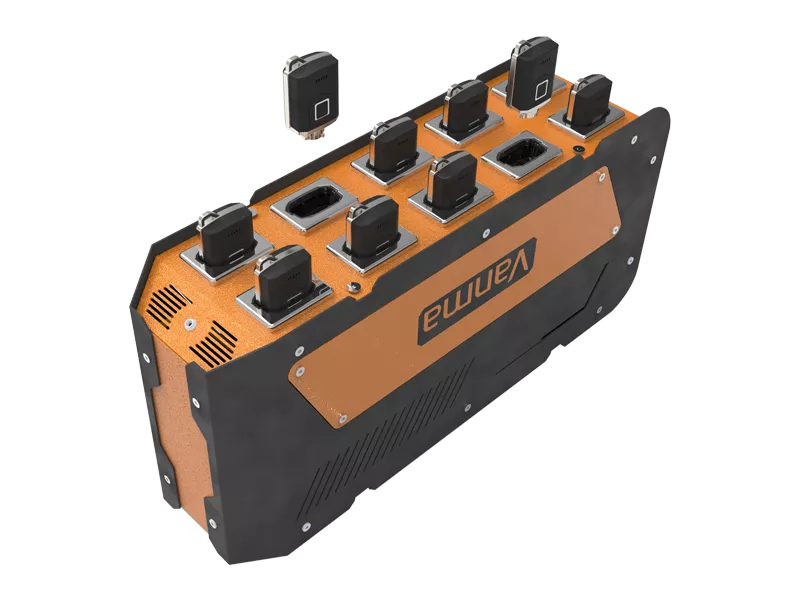
The Vanma lock system is a good example of how this works in practice. Access permissions are set up in advance through management software — who can open which lock, during which hours, for how long. Each key only works within the rules it’s been given, so a warehouse worker’s key might open the loading dock but not the chemical storage cage, and only during their shift. Every time a lock is opened or closed, that event is recorded automatically on the key, and the data can be reviewed by management whenever needed — no need to run cables or install network infrastructure at every single door.
For a warehouse, the practical upside is straightforward: locks that don’t die in the middle of winter, that hold up in dusty or damp conditions, and that still give you a clear record of who accessed what and when — all without turning lock maintenance into its own job.
Warehouse Security Needs Vary by Industry
Not every warehouse faces the same risks, and a one-size-fits-all lock strategy usually leaves gaps somewhere. It helps to look at how security priorities shift depending on what’s actually being stored and who’s moving through the building.
Cold Chain Warehouses

Chemical and Hazardous Material Storage
Third-Party Logistics (3PL) Warehouses
3PL warehouses juggle multiple clients under one roof, with staff, drivers, and sometimes client representatives moving in and out constantly. Managing who can access which client’s storage area gets complicated fast with shared keys or master keys. A system where permissions can be assigned and revoked instantly, without rekeying anything, fits this kind of high-turnover environment far better.
E-commerce Fulfillment Centers
Building a Warehouse Access Control System That Works
A single good lock helps, but a warehouse access control system is what actually ties everything together. This means thinking about access as layers rather than individual doors: who needs to be where, during which hours, and what happens when someone’s role changes.
Permission tiers are the backbone of this. A warehouse supervisor might need access to every door on-site, while a forklift operator only needs the loading bay and the main floor. Night shift staff might need access the day crew doesn’t, and vice versa. Setting this up properly means fewer keys floating around with broad, unnecessary access — which is honestly where most internal theft cases start.
The other piece is traceability. When every unlock event gets logged automatically, security stops being reactive. Instead of trying to reconstruct what happened after a loss is discovered, a manager can simply check the access history and see exactly who was where, and when. This kind of record-keeping also pairs naturally with warehouse management systems already tracking inventory movement — cross-referencing access logs with stock discrepancies makes it much easier to spot patterns instead of one-off guesses.
How to Choose the Right Electronic Padlock for Warehouse Use
Picking an electronic padlock for warehouse use isn’t just about picking the toughest-looking hardware. A few practical questions tend to separate a good choice from a frustrating one:
- Does it need to survive extreme conditions? Cold storage, outdoor yards, and dusty environments all put different stress on a lock. Check the operating temperature range and weatherproofing rating before buying, not after installation.
- How is it powered? A battery-dependent lock means someone, somewhere, has to remember maintenance schedules. A battery-free design removes that recurring task entirely.
- Can permissions be adjusted without physical rekeying? Staff turnover happens. A system that lets you revoke or reassign access digitally saves real time and money compared to swapping cylinders.
- Does it produce usable access records? A lock that “just locks” isn’t giving you the full picture. Look for systems that log unlock events automatically, without requiring a network connection at every door.
- Will it work across different site types? If the same organization runs a warehouse, a yard, and a few storage containers, it’s worth choosing one system that covers all of them rather than mixing three separate lock brands and losing consistency.
Final Thoughts on Warehouse Security Lock Upgrades
rehouse security rarely fails because of one big mistake. It fails in small, unnoticed ways — a shared key nobody tracks, a battery that died overnight, a permission that was never revoked after someone left the job. A solid warehouse security lock strategy closes these gaps quietly, without adding extra work for the people running the facility day to day.
Battery-free systems like the Vanma lock system were built with exactly this kind of everyday reliability in mind — locks that keep working through rough conditions, permissions that can be adjusted in minutes, and a clear record of who accessed what, every single time. If your warehouse still relies on shared keys and locks nobody’s checked in months, it might be worth taking a closer look at where the actual gaps are, and what it would take to close them for good.


Electronic Key
Passive Lock
Management Software
Smart Key Locker
- Infrared sensing
- IP65
- Basic Electronic Lock
- Bluetooth Electronic Lock
- Fingerprint Electronic Lock
- Stainless steel lock body
- No wire require
- IP68
- Audit trail
- Lost key management
- Authorization management
- Reminder of forgetting lock
- Prevent nauthorized access
- Access Trail
- Key charging
Share:
Table of Contents
Try Vanma Electronic Lock
You can contact us to request samples, and to experience the convenience of Vanma electronic locks.
Contact Us Now