
Grain Storage Security: Why the World’s Biggest Food Reserves Are Still Dangerously Easy to Access

A grain depot manager in northern India notices something off during a routine reconciliation. The numbers don’t add up — not by a little, but by enough to matter. The last recorded access to one of the main storage bays was three days ago, but the grain level is lower than it should be. There’s no forced entry. No broken lock. No sign of anything unusual. Just a gap in the records and grain that isn’t there anymore.
This kind of scenario plays out quietly in grain facilities around the world. It rarely makes the news because it rarely happens all at once. It happens in small amounts, repeatedly, over months or years, by people who know the system well enough to know exactly where the gaps are.

The Scale of What's Actually at Stake in Grain Storage Security
How Much Grain the World Is Storing Right Now
Global cereal production has been hovering between 2 and 2.5 billion metric tons annually for the past decade, according to FAO and Statista data. That grain doesn’t disappear from the field to the table — it passes through storage facilities at every stage of the supply chain: on-farm silos, regional depots, national strategic reserves, export terminals.
The countries carrying the heaviest storage responsibilities include China, the United States, India, Russia, and Brazil — each managing reserves that run into tens of millions of tonnes. India’s Food Corporation of India (FCI) alone manages a buffer stock of around 300 lakh tonnes, spread across nearly 1,900 depots and a web of state agency warehouses. The U.S. operates through a combination of private grain elevators and USDA-managed reserves, with compliance requirements governed by federal and state agricultural authorities.
The sheer scale of these operations means that even a small percentage loss translates into enormous figures. And the losses are not small.
What Poor Grain Storage Security Actually Costs
FAO data puts global post-harvest food loss at 13.3% in 2023, up slightly from 13.0% in 2015 when global monitoring began. Not all of that is attributable to access control failures — spoilage, pests, and infrastructure deficiencies play major roles too. But the portion that comes from theft, unauthorized access, and inspection failures that go undetected is harder to measure precisely, which is part of what makes it so persistent.
India offers a documented case study. According to official data released by India’s Ministry of Consumer Affairs, almost 62,000 tonnes of food grain was damaged in FCI warehouses between 2011 and 2017. A separate study estimated that leakages — where subsidised grain intended for the poor is diverted for open market sale — caused the loss of an estimated 25.9 million tonnes of rice and wheat alone. Those aren’t natural losses. Those are access control failures at scale.
Sub-Saharan Africa tells a similar story from a different angle. The World Bank estimates that sub-Saharan Africa loses food grains worth about $4 billion every year — a figure that reflects both physical spoilage and the management gaps that allow losses to compound before anyone notices.
The point isn’t that grain storage security is the only variable. It’s that it’s a significant and underaddressed one, and that the consequences of ignoring it fall hardest on the people and systems that can least afford it.
The Real Threats to Grain Storage Security That Don't Make Headlines
Internal Theft: Quiet, Patient, and Hard to Catch
The mental image of grain theft is usually dramatic — trucks in the night, broken locks, obvious signs of intrusion. The reality is far more mundane and far harder to stop.
Internal theft in agricultural storage environments tends to be gradual. A small quantity skimmed from a large batch. A load that comes in slightly lighter than recorded. A discrepancy chalked up to natural drying shrinkage. In developing countries, post-harvest storage losses of cereals have been documented at up to 30% of stored weight — and while insect damage accounts for a significant portion, human factors are consistently identified as contributors that are systematically underreported.
The reason these schemes persist is structural: without a record of who accessed what and when, the investigative trail is cold before anyone even knows to look for it. An access log that only records “key checked out at shift start” and “key returned at shift end” tells you essentially nothing about what happened in between.
Fumigation Operations: When Access Control Failures Become Life-Safety Failures
Grain storage security isn’t only about theft. In fumigation scenarios, access control failures can be fatal.
Fumigants commonly used for insect control on stored grain include phosphine, and OSHA notes that exposure to fumigants may cause permanent central nervous system damage, heart and vascular disease, and lung edema as well as cancer. These gases may result in a worker passing out and falling into the grain, thus becoming engulfed and suffocating.
The critical safety requirement during fumigation is that no one enters a treated storage structure until gas levels have dropped to safe thresholds. Oklahoma State University extension guidance specifies that before entering any storage structure after fumigation, phosphine levels must be 0.3 ppm or lower.That threshold matters because phosphine has poor warning properties — it doesn’t always smell strong enough at dangerous concentrations to trigger instinctive avoidance.
The grain storage security problem here is specific: if the lock on a fumigation bay can be opened by anyone with a physical key, there’s nothing to stop an uninformed worker from entering a space that should be sealed. A policy posted on a wall doesn’t enforce itself. A lock that responds to gas concentration data, or that requires management-level authorization to open during a fumigation window, does.
Inspection Gaps: The Records Look Fine, But Nobody Actually Checked
Grain condition monitoring — temperature, humidity, insect activity — depends entirely on inspections actually happening and those inspections being honestly recorded. Manual inspection logs can be falsified. Rushed workers skip checks and backfill the paperwork. This isn’t speculation; it’s a well-documented pattern in large-scale grain storage operations worldwide.
The downstream consequence is that problems get discovered late. Grain that has been heating in a pocket of moisture for three weeks looks fine on the inspection log until someone actually opens the bay and smells it. By that point, the damage has spread.
Grain storage security, properly understood, includes the integrity of the inspection process — not just the physical security of the doors.
Why Traditional Lock Systems Keep Failing Grain Storage Security
Mechanical Keys Don't Record Anything
Battery-Powered Electronic Locks Have Real Limits in Agricultural Environments
High humidity, grain dust, temperature extremes — from sub-zero winters in northern storage facilities to the heat of tropical silos — and the chemical environment created by fumigation gases all shorten the lifespan of batteries and electronic components faster than manufacturers’ specs suggest. A lock that performs fine in a warehouse in mild conditions may behave differently after two years of exposure to the kind of environment a large grain depot actually creates.
More practically: a dead battery in a remote storage facility means either an emergency workaround that bypasses the whole security system, or a maintenance call that may take hours or days depending on location. Neither outcome is acceptable for grain storage security.
How Passive Electronic Locks Improve Grain Storage Security


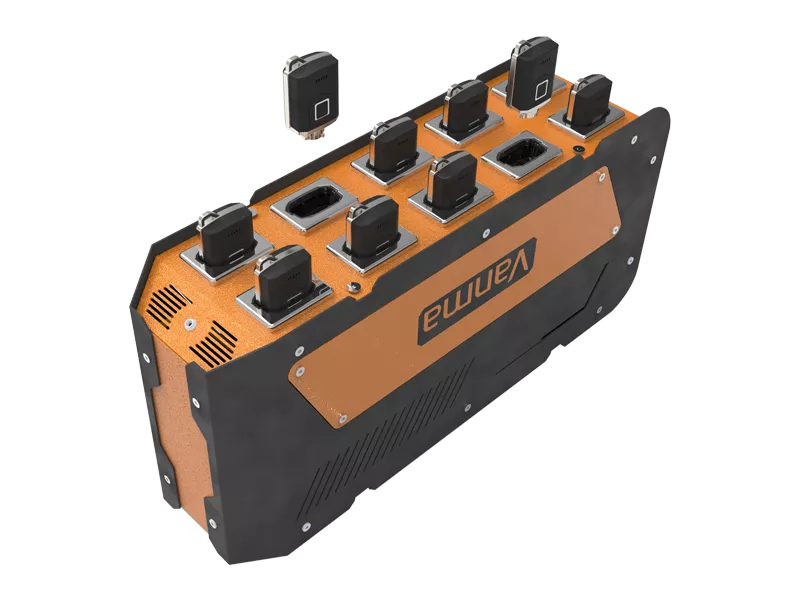
Electronic Key
Passive Lock
Management Software
Smart Key Locker
- Infrared sensing
- IP65
- Basic Electronic Lock
- Bluetooth Electronic Lock
- Fingerprint Electronic Lock
- Stainless steel lock body
- No wire require
- IP68
- Audit trail
- Lost key management
- Authorization management
- Reminder of forgetting lock
- Prevent nauthorized access
- Access Trail
- Key charging
No Battery in the Lock Means No Failure at the Worst Moment
This design is well-suited to grain storage environments for a direct reason: there are no battery-dependent components inside the lock to fail due to humidity, temperature swings, dust exposure, or fumigation chemical contact. The lock body is rated IP68 — meaning it can handle dust and water immersion — and Vanma’s range includes models certified to ATEX explosion-proof standards, which matter in environments where grain dust concentrations can reach combustible levels during active operations. The operational temperature range covers -40°C to 70°C, which puts it comfortably inside the envelope of most real-world grain storage conditions.
Maintenance burden drops considerably. There are no batteries to track, schedule, or replace across a large facility with dozens of access points. The electronic key carries the power source and the firmware — and key charging and updates are managed centrally through a key cabinet, not through individual lock servicing.
Every Access Event Gets Logged — And Fake Inspections Become Much Harder
Every time a Vanma key contacts a lock, the system records the key’s unique hardware ID, the timestamp, and the lock identifier. That record is stored in tamper-resistant memory and syncs to a management platform when the key returns to its docking station or enters network range. It cannot be altered after the fact.
For grain storage security specifically, this changes the inspection dynamic in a concrete way. Management can configure a required inspection sequence — Lock A in Warehouse 1 must be opened before Lock B, which must be opened before Lock C — and the system records whether that sequence was actually followed. If an inspector skips a bay, it shows up. If a bay is accessed outside of authorized hours by an authorized key, it shows up. If a key that should have been returned at shift end is still being used two hours later, it shows up.
This is the difference between a paper inspection log and a tamper-resistant digital record. The paper log records what someone chose to write down. The electronic log records what actually happened.
Fumigation Lockout: Enforced at the Hardware Level
For fumigation scenarios, Vanma locks can be set to a maintenance mode — a configuration in which no key, regardless of authorization level, can open the lock until a manager with appropriate credentials explicitly lifts the restriction. This is enforced by the hardware, not by a posted notice or a verbal instruction.
For higher-risk operations, dual-authorization can be configured: the lock requires two different keys held by two different individuals to open, simultaneously or in sequence. Neither person can open the bay alone. This maps directly onto the two-person safety requirement that responsible fumigation practice demands — and unlike a policy, it can’t be waived because someone is in a hurry or assumes the other person already checked.
One Key, Full Accountability, Across Every Storage Point
A single Vanma key can be authorized to open multiple locks across a facility, with permissions set by individual, by time window, by day of week, and by specific location. A maintenance contractor’s key can be configured to work only between 9 a.m. and 4 p.m. on weekdays, only at the specific bays they’re authorized to enter. When their contract ends, their key is blacklisted through the management software — no lock change required, no key collection chase.
Compared to a ring of mechanical keys that may be duplicated, borrowed, or passed along without documentation, this reduces the uncontrolled key population dramatically. In large facilities where dozens of personnel have had access over years of operation, that reduction in key sprawl closes a grain storage security gap that most operators didn’t even know they had.
Putting Grain Storage Security Into Practice
Start With an Honest Access Audit
Before changing any hardware, the most useful first step is finding out where the current system actually has gaps. That means mapping every access point across the storage operation — main bay doors, side entries, ventilation control points, fumigation entry hatches, temperature monitoring equipment housings — and asking for each one: who currently has a key, how is access documented, and what would the records show if something went wrong here tonight?
Most operators who do this exercise honestly find the picture is worse than they expected. That’s not a criticism — it’s just what happens when access control grows organically over years without a systematic review. The audit isn’t about blame; it’s about knowing what you’re actually working with.
Match the Control Level to the Risk Level
High-risk areas — main storage bays, fumigation entry points, temperature sensor equipment — warrant dual-authorization requirements, mandatory access sequencing, and full audit logging. These are the points where a single unauthorized or unrecorded access could mean significant financial loss or a worker safety incident.
Operational access points — equipment storage, vehicle loading bays, supervisor offices — benefit from individual key assignment and time-restricted permissions, so that the access log is meaningful even without dual-authorization overhead.
General facility access — perimeter gates, utility connections, general maintenance areas — can be managed with basic permission tiers and logging, which still represents a major improvement over untracked mechanical keys.
Build the Audit Log Into Daily Management, Not Just Incident ResponseThe grain storage security value of an electronic access log isn’t only in what it shows after something goes wrong. It’s in what it shows before that — if anyone is actually looking at it.
Building a daily review of the previous shift’s access data into supervisor handover routines catches anomalies early: a bay opened at an unusual time, an inspection sequence that was completed out of order, a key that was used after its authorization window expired. These are the kinds of signals that, in a mechanical key environment, simply don’t exist. In a passive electronic lock system, they’re there every day, waiting to be read.
Grain Storage Security Doesn't Have to Be This Hard
The honest frustration with grain storage security is that the tools to fix most of these problems have existed for a while. The gap isn’t technical — it’s that the problem has been treated as a second-tier priority in an industry where the visible, dramatic risks get the attention and the quiet, persistent ones don’t.
Passive electronic lock systems like Vanma’s don’t require rewiring a facility, running new cables across a large depot, or replacing every door. They slot into existing door hardware, they work without a power connection, and they give operators something they haven’t had before: a complete, tamper-resistant record of who accessed what, when, and whether they were supposed to.
If the inspection log from last week shows every bay checked on schedule, but the access data shows one bay that wasn’t actually opened on two of those days — that’s a conversation worth having before the next reconciliation turns up a shortfall.
Is Your Facility's Access Control Telling You the Truth?
If you manage grain storage at scale — whether that’s a single large depot or a network of regional facilities — it’s worth asking whether your current access records would actually support an investigation if something went wrong.
Vanma’s passive electronic lock system was built for exactly the environments grain storage presents: outdoor exposure, extreme temperatures, high-dust conditions, 24/7 operation, and the need for an audit trail that can’t be quietly edited.
Talk to the Vanma team about what a realistic deployment looks like for your facility.
Share:
Table of Contents
Try Vanma Electronic Lock
You can contact us to request samples, and to experience the convenience of Vanma electronic locks.
Contact Us Now