

In Punjab, India, nearly 4.72 lakh tonnes of wheat sat deteriorating in open storage areas over several years. When India’s Comptroller and Auditor General finally reviewed the situation, the wheat — valued at over ₹700 crore — had been declared unfit for the public distribution system. The CAG report pointed to a familiar list of causes: poor monitoring, negligence by custodian staff, and a failure to maintain basic storage conditions.
Halfway around the world, an American grain worker entered a silo that had been fumigated with phosphine a day earlier. Nobody had confirmed the gas had cleared. The lock on the entry hatch had been opened with the same key everyone on site carried. There was no record of who had gone in, no authorization trail, and no hardware-level restriction preventing access during an active fumigation window.

These two stories are separated by thousands of miles and very different contexts, but they share a common thread: the grain silo lock — that most basic piece of site security — either wasn’t doing its job, or wasn’t being asked to.
This article looks at where the world’s grain reserves actually stand, what’s going wrong in facilities across major producing nations, and why the grain silo lock sitting on most storage bay doors today is a bigger liability than most facility operators realize.
How Much Grain the World Is Actually Storing — and Why Grain Silo Lock Management Matters at Scale
The Numbers Are Staggering
What Real Incidents Tell Us About Grain Silo Lock Failures
The Punjab CAG case described at the start of this article isn’t an outlier. According to an RTI reply from India’s Ministry of Consumer Affairs, almost 62,000 tonnes of food grain was damaged across FCI’s 1,889 warehouses between 2011 and 2017. A separate estimate found that “leakages” — where subsidized grain meant for the poor was diverted to open markets — caused the loss of an estimated 25.9 million tonnes of rice and wheat alone
More recently, a CAG audit of Haryana’s procurement agencies found that 79,967 MT of wheat was damaged between 2017 and 2021, resulting in a loss of ₹174.58 crore. The auditors pointed specifically to “poor internal control and poor monitoring” as the root causes — not natural disaster, not pest infestation, but a failure of oversight. The wheat was there. The people responsible for watching it were there. The system for ensuring accountability simply wasn’t.
None of this happens in a vacuum. When grain disappears gradually, or spoils in patches, or is diverted in small quantities over a long period, the grain silo lock is often the only point in the system where accountability could have been created — and wasn’t.
The Unique Challenges That Make Grain Silo Lock Management So Difficult
Grain Facilities Are Physically Hostile to Most Hardware
Ask anyone who’s worked in a large grain depot and they’ll tell you: it’s a rough environment for equipment. Humidity runs high, often exceeding 85% in regions with seasonal rainfall. Grain dust during active operations can reach concentrations approaching the combustible threshold. Temperature swings between winter and summer in northern storage facilities can exceed 60°C. And during fumigation cycles, the chemical environment inside a silo is actively hostile to both people and electronics.
Standard padlocks rust, seize, and corrode faster in these conditions than they do in normal storage environments. A lock that works fine in September may be frozen stiff by January or corroded past function by the following spring. When that happens, workers don’t stop and wait — they improvise. They cut the lock, prop the door, or use a different entry point. Each improvised solution is a gap in the access record that nobody logs.
Battery-powered electronic locks have their own problems in this environment. Moisture and grain dust get into sensors. Extreme cold drains batteries faster than rated. Fumigation chemicals create an atmosphere that accelerates corrosion of electronic components. A large facility might have thirty or forty of these locks across its access points — tracking battery status, replacing them on schedule, and responding to failures across a facility spread over several hectares is a logistical challenge that quietly adds up.
The Key Problem: Too Many People, No Record
A medium-sized grain depot might have eight to twelve distinct access points that need active management: main bay doors, side ventilation hatches, temperature monitoring equipment housings, fumigation entry points, vehicle loading bays. Add in the range of personnel who legitimately need access — depot managers, inspectors, laborers, fumigation contractors, transport drivers, government auditors — and you’re looking at a grain silo lock system that is functionally shared among a large group of people with very different levels of training and accountability.
Mechanical keys don’t distinguish between any of them. The same physical key that a depot manager uses to conduct a quarterly audit is, in many facilities, the same key that a day-labor loading worker uses to access the bay. When a discrepancy turns up, the list of people who could be responsible is long, and the evidence needed to shorten that list doesn’t exist.
Fumigation: Where a Grain Silo Lock Failure Stops Being a Financial Problem
Phosphine fumigation is standard practice for insect control in stored grain. It’s also one of the most hazardous operations that occurs in a grain facility.
OSHA documents clearly that exposure to fumigants can cause permanent central nervous system damage, heart and vascular disease, and lung edema. The gas has poor warning properties — its fish-and-garlic odor, detectable at low concentrations, is not a reliable indicator of dangerous levels. Critically, OSHA’s permissible exposure limit for phosphine is 0.3 ppm, but recorded worker exposures during fumigation operations have been measured as high as 52 ppm in CDC industrial hygiene surveys — more than 170 times the safe limit.
The grain silo lock problem here is direct: if anyone with a physical key can open a fumigation bay door during or shortly after treatment, no safety briefing or posted warning prevents entry. A worker who doesn’t know the fumigation is active, or who assumes a few hours is long enough, can open that door and walk into a space with lethal gas concentrations. As OSHA notes, “far too many preventable incidents continue to occur in the grain-handling industry.” The agency has issued warnings to approximately 13,000 grain elevator operators — not because the hazards are unknown, but because the access controls to enforce safety protocols at the hardware level are often inadequate.
Why Standard Grain Silo Lock Options Keep Falling Short
The Mechanical Padlock: Familiar, Cheap, and Full of Gaps
The mechanical padlock earns its place in grain facilities by being inexpensive, weatherproof enough for most conditions, and requiring no technology whatsoever to use. It’s the grain silo lock that most operators reach for by default, and it does its basic job — keeping a door closed against someone who doesn’t have a key.
What it cannot do is tell you who used it, when, whether that person was authorized to be there, or whether they locked the door again when they left. It can be duplicated at a hardware store for a few dollars. It can corrode and jam in harsh conditions. And once a key is out in the world, there’s no way to revoke access without physically collecting every copy and changing the lock.
These are not edge cases. They’re how mechanical key systems behave in real facilities with real turnover among staff and contractors.
Battery-Powered Electronic Locks: Better, But Not Built for This
Battery-powered electronic locks solve the access logging problem and add meaningful functionality — remote authorization, audit trails, revocable credentials. The challenge is that grain storage environments put pressure on exactly the components these systems depend on.
High humidity accelerates battery discharge and corrodes contacts. Grain dust blocks sensor apertures. Fumigation gases attack circuit boards. Temperature extremes — particularly the kind seen in northern hemisphere storage facilities through winter — cut battery capacity dramatically and unpredictably. A facility manager who installs electronic locks across a large depot may find that a meaningful percentage of them are unreliable within two or three seasons without significant ongoing maintenance effort.
There’s also a practical failure mode that nobody wants to talk about: a dead electronic lock at 2 a.m. during a loading operation is a problem that gets solved immediately, one way or another. The “solution” often involves a bypass that was never supposed to be part of the system.
How a Passive Electronic Grain Silo Lock System Actually Fixes These Problems


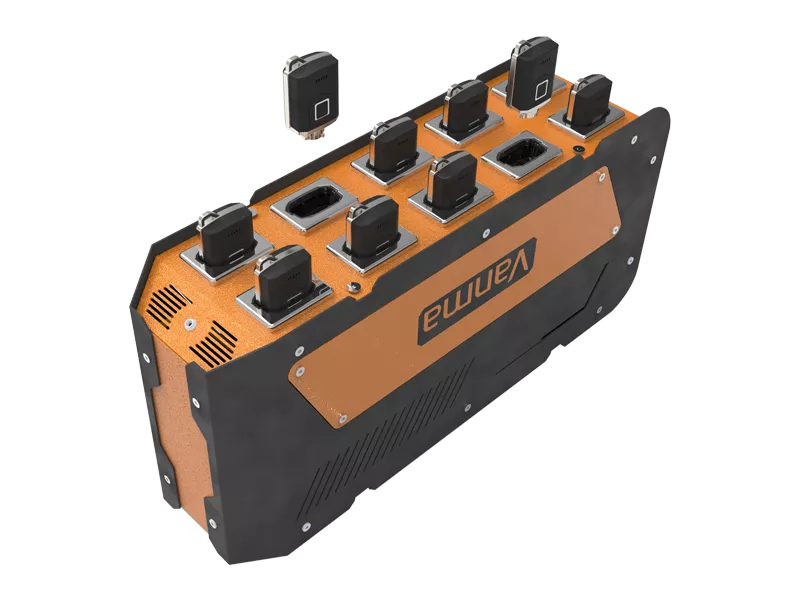
Electronic Key
Passive Lock
Management Software
Smart Key Locker
- Infrared sensing
- IP65
- Basic Electronic Lock
- Bluetooth Electronic Lock
- Fingerprint Electronic Lock
- Stainless steel lock body
- No wire require
- IP68
- Audit trail
- Lost key management
- Authorization management
- Reminder of forgetting lock
- Prevent nauthorized access
- Access Trail
- Key charging
No Battery in the Lock — No Battery to Fail
Vanma’s passive electronic lock system takes a different approach to the power problem by removing batteries from the lock body entirely. The lock itself has no internal power source. When an authorized electronic key makes contact with the lock, it supplies a brief burst of power — enough to verify the key’s identity, record the access event, and complete the unlock action. Then the connection ends and the lock returns to a fully passive state, drawing nothing.
This matters for grain storage environments in specific, practical ways. There’s no battery inside the lock to drain in January when temperatures drop. There are no electronic components inside the lock to corrode from fumigation gases or grain dust. The lock body is rated IP68 — fully dust-tight and able to withstand water immersion — and Vanma’s range includes models certified to ATEX explosion-proof standards, which cover environments where grain dust concentrations can reach combustible levels during active operations. The working temperature range of -40°C to 70°C covers the realistic conditions of grain storage facilities from northern Russia to subtropical Brazil.
One grain silo lock unit installed and it requires essentially no ongoing maintenance. That’s not a marketing claim — it’s a direct consequence of having no moving electronic parts inside the lock body.
Every Grain Silo Lock Access Gets Logged — Including the Ones Nobody Was Supposed to Make
Each time an electronic key contacts a Vanma lock, the system records the key’s unique hardware ID, the exact timestamp, and the lock identifier. That record is stored in tamper-resistant memory within the key and syncs to a management platform automatically when the key returns to its docking station.
For grain facility management, this creates something that didn’t exist before: a complete, uneditable record of who opened which silo door at what time. If a bay is accessed outside authorized hours, it shows up. If an inspector’s route is supposed to cover six points but only four lock records appear in the log, that shows up too. If a key that belongs to a contractor who finished their contract three weeks ago shows up in the log — that shows up, and the blacklist function means that key won’t work again without active reauthorization.
Vanma can also be configured to enforce mandatory inspection sequences: Lock A must be opened before Lock B, which must be opened before Lock C. Skipping a step in the route isn’t just against procedure — it becomes visible in the system log as a gap. Inspection reports that don’t match access logs are a problem that surfaces before the end of the shift, not at the next annual audit.
Fumigation Lockout: The Grain Silo Lock That Enforces Safety at the Hardware Level
For fumigation scenarios specifically, Vanma locks can be placed in a maintenance mode — a state in which no key, regardless of its authorization level, can open the lock until a manager with appropriate credentials explicitly releases it. This is enforced by the lock hardware, not by a laminated safety sign or a verbal instruction at the start of shift.
For higher-risk fumigation entry points, dual-authorization can be configured: the lock requires two separate keys, held by two different people with different permission levels, operated in sequence. Neither key works alone. This maps directly onto the two-person entry protocol that safe fumigation practice requires — and unlike a policy, it can’t be waived because one person is running late or assumed the other already checked the gas levels.
The OSHA recommended approach to grain bin entry is to ensure a permit is issued certifying that precautions have been implemented before any worker enters. A passive electronic lock in maintenance mode is the hardware enforcement of exactly that permit system — the entry physically cannot happen until the certification steps are complete.
One Key, Full Control, Across Every Access Point
A single Vanma electronic key can be authorized to manage multiple locks across an entire facility, with permissions configured by person, by time window, by day, and by specific lock. A fumigation contractor’s key can be set to work only during active contract periods, only at the specific entry points for their work scope. A government auditor’s key can be granted single-visit access that expires at end of day.
When a worker leaves, their key goes on the blacklist through the management software. No lock change. No key collection. No waiting to see whether they hand back a copy. The credential is dead at the hardware level from that moment forward.
In facilities where key sprawl has built up over years — where multiple copies of the same mechanical key are floating around the supply chain — this kind of clean credential management closes a grain silo lock gap that most operators didn’t even know they were sitting on.
What a Practical Grain Silo Lock Upgrade Looks Like
Start With the Points That Matter Most
Not every door in a grain depot carries the same risk, and the upgrade doesn’t have to happen everywhere at once. The places to start are those where an unauthorized or unrecorded access would have the biggest consequences: main storage bay doors, fumigation entry hatches, and temperature monitoring equipment housings.
A rough prioritization: if something went wrong here tonight and you needed to show an auditor who had access over the last 72 hours, could you? If the answer is no, that’s where to start.
Fitting Passive Locks Into an Existing Facility
Build the Access Log Into How the Facility Runs Day to Day
An electronic access log is only useful if someone looks at it. The facilities that get the most value out of this system are the ones that build a brief daily log review into their standard handover process — supervisor checks the previous shift’s access data before signing off. Unusual patterns (a bay opened at 3 a.m., a temperature probe access that doesn’t match the inspector’s claimed route) surface within hours rather than months.
That early-warning function is, honestly, where most of the value is. The log’s job isn’t to help you investigate after something goes wrong. Its job is to give you enough visibility that things go wrong far less often.
Is Your Facility's Grain Silo Lock Doing What You Think It Is?
Share:
Table of Contents
Try Vanma Electronic Lock
You can contact us to request samples, and to experience the convenience of Vanma electronic locks.
Contact Us Now